
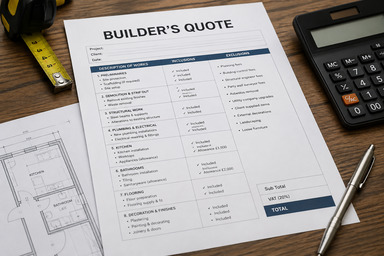
Getting a builder’s quote is often treated as the point where a homeowner finally learns what a renovation will cost. In reality, the number at the bottom of the page is only useful if the document explains exactly what that number covers.
A proper quote should allow you to understand the scope, materials, responsibilities, assumptions and payment structure before work starts. If those details are missing, comparing two prices becomes difficult and disagreements later become much more likely.
For a substantial renovation, a good quotation should answer more than “how much?”. It should explain what is being built, what has been allowed for, what remains uncertain and what sits outside the price.
The Scope of Work Should Be Specific
The first thing a quotation should tell you is exactly what the builder is proposing to do.
“Full refurbishment” is not a meaningful scope on its own. A useful quote should break the project into recognisable stages: strip-out, structural alterations, plumbing, electrics, plastering, kitchen installation, bathroom work, flooring, carpentry and decorating.
If you are planning a complete house refurbishment in London, that level of detail becomes particularly important because several trades may be working on the same property.
A clear scope makes it easier to identify omissions before the work is agreed and gives both sides a reference point if questions arise during the project.
Check What Has Been Allowed for Materials
A quotation can look complete while still leaving a large part of the final cost undecided.
Ask which materials are included and what allowance has been made for them. There is a major difference between a price that includes basic building materials and one that assumes the client will supply important items separately.
Kitchens and bathrooms are obvious examples. A kitchen refurbishment quote may include installation labour but not cabinetry, appliances or worktops. A bathroom refurbishment price might include plumbing and tiling labour while sanitaryware and tiles remain client-supplied.
The important point is that you should be able to see clearly what you are expected to purchase separately.
Allowances and Provisional Sums Need Attention
Some parts of a project cannot be priced precisely before work begins, so the builder may include an allowance or provisional amount.
That can be reasonable when the uncertainty is genuine, but it needs to be visible. If a quote contains several large provisional sums, the total at the bottom may not be the amount you eventually pay.
Ask what each allowance covers, why it cannot yet be fixed and what circumstances would cause the figure to change.
Exclusions Matter as Much as Inclusions
One of the quickest ways to misunderstand a building quote is to read only what is included.
A good quotation should also make important exclusions obvious. These could include planning fees, structural engineer fees, building control charges, specialist surveys, utility-company work, asbestos removal, bespoke joinery or client-selected fixtures.
If one builder includes waste removal, floor protection and final decorating while another excludes them, their totals cannot be compared fairly.

Preparation and Making Good Should Be Clear
Homeowners naturally focus on the finished kitchen, bathroom or new layout, but a large amount of building work happens before and after the obvious installation.
Removing an old kitchen can damage plaster. New electrical routes need making good. Plumbing alterations may require floors or walls to be opened. Structural work creates areas that need plastering, carpentry and decoration afterwards.
If the quote covers the main installation but says nothing about preparation or making good, clarify it. This matters particularly in older London properties, where opening existing finishes can reveal surfaces that need more work than expected.
Waste Removal and Site Protection Should Not Be Assumed
London sites can be awkward. Parking restrictions, narrow access, shared hallways and limited space for storing materials all affect how a project is managed.
The quotation should make clear who is dealing with construction waste and whether protection to existing floors, stairs, doors and communal areas is included.
These details consume real labour and time, so they should not simply be assumed to be part of the price.
Understand the Payment Schedule Before Work Begins
A quotation should not leave payment arrangements until after the project has started.
For larger renovations, payments are often connected to stages of work. The exact structure can vary, but you should understand when each payment becomes due and what progress it relates to.
Before agreeing to the project, check whether deposits, stage payments, material payments and the final balance are clearly explained.
The Programme Should Be Realistic
A quotation may also include an estimated start date and project duration. Ask what needs to happen before work begins, whether specialist items have long lead times and whether the programme assumes uninterrupted access to the property.
A realistic programme should reflect the sequence of trades and the actual scope of work, rather than simply offering the most attractive completion date.
Variations Should Have a Clear Process
Even a detailed renovation quotation cannot predict every decision or hidden condition.
You may add work after construction begins, or the builder may uncover something that could not reasonably have been identified beforehand. The important point is how those changes are handled.
Ask how additional work will be priced and approved. Wherever practical, you should understand the cost of a variation before the extra work proceeds.
This helps prevent the final account from becoming a collection of unexpected extras that were never properly discussed.
Check Who Is Responsible for Permissions and Specialist Work
A builder’s quote should not leave you guessing about professional or statutory requirements.
Depending on the project, you may need drawings, structural calculations, planning approval, building control involvement, a party wall process or specialist inspections.
Do not assume these are included simply because the building work depends on them. The quotation should either include the relevant service or make clear that it sits outside the contractor’s price.
Pay Attention to the Assumptions Behind the Price
Quotes are prepared using the information available at the time. Where the builder has made assumptions, those assumptions matter.
For example, a price might assume that the existing subfloor is sound, drainage is suitable or walls do not contain unexpected structural defects.
A reasonable assumption is not a problem. A hidden assumption is. If an important part of the price depends on something that has not yet been confirmed, it should be understood before you sign.
Do Not Compare Builder Quotes by the Bottom Line Alone
A £70,000 quote and an £85,000 quote do not necessarily represent a £15,000 saving.
If the lower quote excludes decorating, waste removal, electrical upgrades and several material allowances, its final cost could end up much closer to — or even above — the apparently expensive option.
Compare scope against scope. Check the specification, allowances, exclusions, responsibilities and payment terms before focusing on the total.
Choosing experienced builders in London should involve assessing how well the contractor has understood and documented the project, not only how attractive the first number looks.
Final Thoughts
A proper builder’s quote should reduce uncertainty before construction starts. It should tell you what is being built, what is included, what is excluded, which amounts remain provisional, who is responsible for additional requirements and how payments will work.
The clearer those points are at the beginning, the easier it becomes to compare contractors properly and control the renovation once work starts.
Right Build Group follows a straightforward process from site survey and discussion of your requirements through to receiving a quotation and booking the work. If you are planning a renovation in London, contact our team to arrange a survey and discuss the scope of your project before making a commitment.