
RIGHT BUILD GROUP · MAIDA VALE
Bathroom Refurbishment in Maida Vale
A partial refit needs clear edges. Plan your Maida Vale bathroom upgrade around what stays, what is removed and how the new installation meets the existing room.
- Selected upgrades assessed
- Retained finishes considered
- Scope boundaries agreed before work

A ROOM YOU USE EVERY DAY
Keeping part of the room is a positive decision.
A sound bath, useful basin or well-planned layout may not need replacing simply because another part of the room has become tired. For a Maida Vale upgrade, begin by listing what works and what does not. Then assess whether those retained parts allow a sound, useful replacement around them.
Right Build’s bathroom refurbishment includes partial and full installations, preparation, plumbing, electrical work, tiling, joinery and decoration. At a no-obligation survey, we discuss the work’s boundaries as carefully as its new products. A visually small change can still reach behind the existing finish.
CHOOSE THE RIGHT SCOPE
Define the limited intervention precisely.
Replace the basin and furniture
Review the existing connections, unit dimensions and surfaces revealed by removal. A new vanity may differ in height or footprint and expose unfinished wall or floor. Include that making good rather than assuming the furniture can hide every change.
Renew a defined shower area
Assess the tray, waterproofing, controls and background as a connected installation. Retained surrounding finishes need explicit junctions. Replacing the visible tile alone may not address the condition or cause of a failing wet area.
Broaden the refit where necessary
If the assessment shows that retention prevents a sound repair or workable layout, compare a wider scope. Keep necessary repairs distinct from optional improvements, so a partial brief can develop through informed decisions rather than uncontrolled additions.

LAYOUT BEFORE FINISHES
Look closely at the new-to-old junction.
Removing one item can uncover the edge of another: old tile behind a basin, incomplete flooring under a unit or a previous repair hidden by boxing. Show those areas where possible and agree how concealed findings will be reviewed if they are not visible until removal.
Matching a product is more than matching its colour. Thickness, dimensions, connection requirements and surface condition influence how it will meet the retained room. Discuss the possibility of a deliberate finish boundary instead of assuming an exact match will be available.
Decide what retained means in practical terms. Does the bath stay untouched, or will its surrounding tiled area change? Does the old floor continue beneath the new unit? A surface-by-surface description makes the quotation clearer than a general request to replace only the dated bits.
WHAT HAPPENS, AND WHEN
Keep the boundaries visible through the work.
A partial installation still needs an orderly sequence. Its advantage depends on the condition of what remains, while removal may expose a reason to review the scope before replacement finishes are applied.
| Stage | What happens | Your decision point |
|---|---|---|
| Retention and condition review | Identify retained fittings, surfaces and the intended changes. | Agree the boundaries and known uncertainties. |
| Selective removal | Remove the specified items and inspect newly exposed areas. | Review damage or incomplete finishes before reinstatement. |
| Connections and preparation | Arrange plumbing, electrical changes and suitable backgrounds. | Confirm compatibility and wet-area junctions. |
| Replacement and making good | Fit the selected products and finish the agreed transitions. | Review new-to-old edges and maintenance access. |
| Final review | Check operation and finishing across the replacement area. | Understand what was renewed and what remains existing. |
THE TECHNICAL DETAILS
Retained does not mean technically proven.

Check the replacement connections
The new basin, shower or WC must suit the existing supply and waste arrangement or have assessed alterations. Share technical specifications before ordering. A similar external shape does not establish identical connection positions.
Maintainable access to traps, valves and isolation points should remain part of the installation. If new furniture or boxing conceals them, agree how they are reached. Retention should not make the new work depend on an inaccessible component.
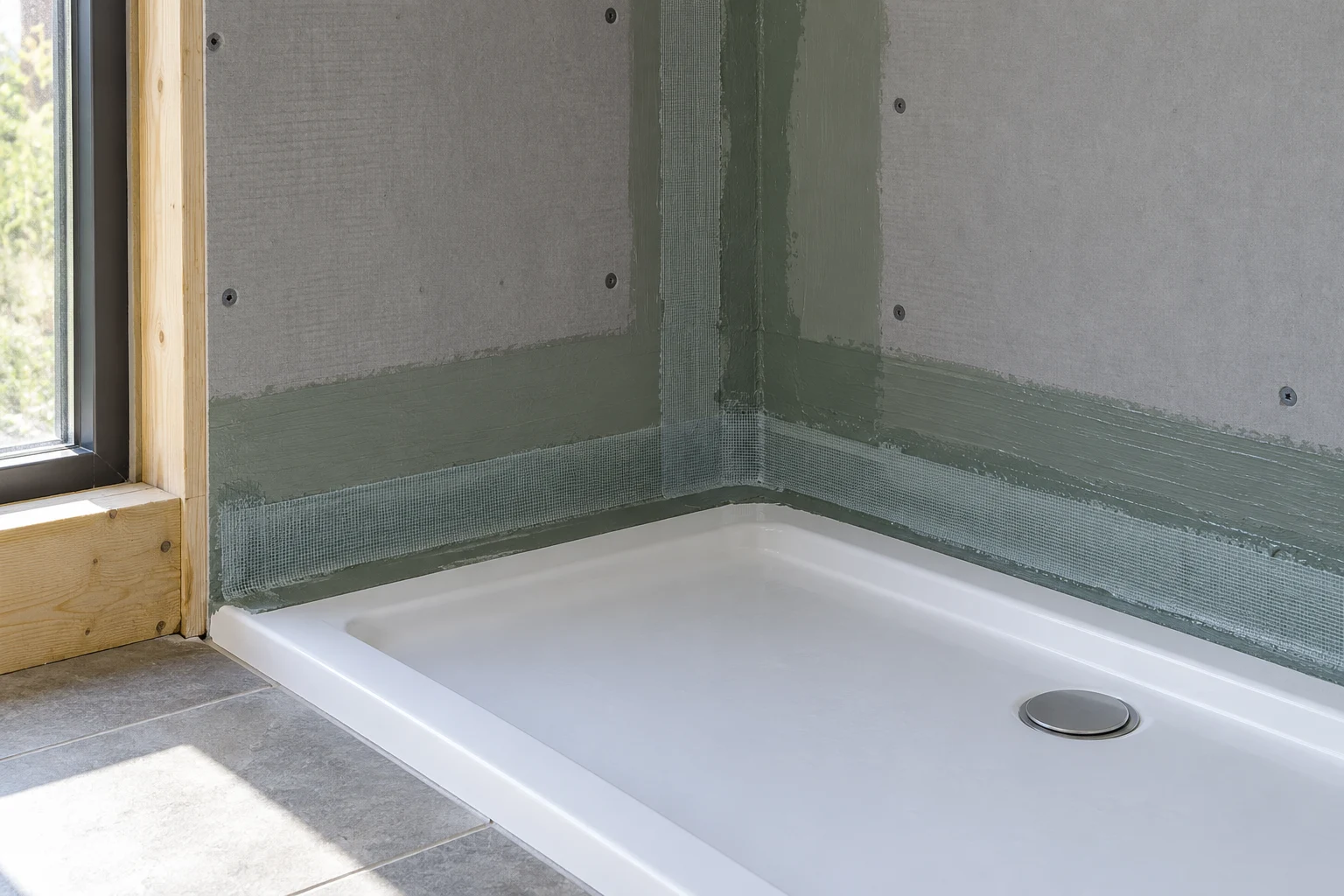
Assess the wet-area boundary
A renewed shower section needs appropriate background and waterproofing details. Identify how the new system meets retained material rather than assuming the waterproof layer continues behind every old tile. Ordinary grout is not sufficient evidence of a sound wet area.
If damp or unstable material is exposed, investigate before covering it. Follow the selected system’s instructions and required curing periods. A partial repair should be specified around the assessed condition, with limits discussed plainly where retained surfaces cannot be fully inspected.

Set out the finish transition
Review thickness, edges and cuts between new and old tiles, furniture and painted surfaces. An exact product match may not be available, so agree the intended appearance before installation rather than relying on a discovery at the end.
Background stability and floor suitability still matter in the replacement area. Choose new surfaces for their wet use and care needs, and discuss cleaning around retained fittings. Keep product information so the different parts of the completed room can be looked after appropriately.
AIR, LIGHT & EVERYDAY COMFORT
Check what the upgrade leaves in service.
Retaining the fan does not establish that the ventilation arrangement suits the proposed room. Review its route and discharge where relevant, particularly if a shower change or new boxing affects it. Discuss access before other work closes the area.
Any electrical changes need appropriate assessment, including lighting, heated mirrors and towel rails. Confirm suitability and positions with the electrician before final finishes. A small product replacement should not be used to bypass the installation requirements that apply to it.
PLANNING THE WORK IN MAIDA VALE
Describe the existing room honestly.
For a Maida Vale partial upgrade, make two simple lists: retained items and replacements. Add photographs showing where they meet. This is particularly useful around a basin footprint, bath edge or shower enclosure, where removal can expose an unfinished area that the product photograph does not show.
Share any earlier repair information and the exact replacements you have found. Distinguish a preference for keeping a surface from certainty about its concealed condition. Agree how findings will be reviewed so neither installer nor owner is forced to improvise the boundary once work is open.
Decide what an acceptable transition looks like if the old finish cannot be matched. A deliberate change of material or a wider replacement area can be discussed, but it should be a conscious scope decision. Keep necessary making good separate from further optional changes.
WORKING WITH RIGHT BUILD GROUP
Agree changes before the partial scope expands.
List what stays and what goes
Send wide and detailed photographs and describe the current problem. Share the replacement products and any limits important to you.
Assess the junctions at the survey
Review condition, compatibility and making good. Agree the written scope and a clear approach to findings that appear after removal.
Review newly exposed material
Discuss damage, unmatched finishes or connection changes before the installation covers them. Keep necessary repair separate from optional upgrades.
Check the renewed and retained parts
At handover, review operation and the agreed transitions. Retain care information and understand which components remain part of the existing room.
BUILDING A USEFUL QUOTATION
Compare partial work on its real boundaries.
Keeping suitable fittings may reduce replacement, but new-to-old junctions and making good still require work. A low count of new products does not itself describe preparation or connection tasks. Ask for those elements to be understandable in the quotation.
A wider replacement may become worth comparing if retention obstructs a sound repair. That should be an explained decision based on condition, not an assumption that every partial project must grow. Agree how additional findings will be assessed and authorised.
Product compatibility, tile matching, electrical items and joinery affect the proposal alongside the retained suite. Check availability and responsibilities before dates are set. Discuss the room’s use during the work rather than assuming a partial refurbishment means uninterrupted access.
BEFORE YOU COMMIT
Questions worth asking.
Can I keep the bath and change only the basin?
Explore the proposed unit, connections and finish boundaries at the survey. Include any wall or floor areas exposed by removing the existing basin, rather than assuming the bath’s retention makes the rest straightforward.
Will the old tiles match the new ones?
Do not rely on appearance alone. Check availability, size and thickness and agree an alternative finish boundary if an exact match is not practical.
Can only part of a shower be waterproofed again?
The assessed background and junction with retained work need a suitable specification. Discuss the limits of the existing material rather than assuming a membrane continues soundly behind unseen tiles.
What if a small removal exposes a large repair?
Review the condition, cause and proposed response before proceeding. A new repair should be described with its effect on the agreed scope, not absorbed into a vague finishing task.
Can new boxing improve the partial installation?
Discuss pipe boxing and joinery with maintenance access and finish boundaries in view. It should not simply conceal unresolved connections.
What if damage reaches beyond the selected upgrade?
Assess the wider affected material before covering it. Include appropriate water damage repairs where the condition requires them, rather than limiting the response to the chosen product’s footprint.
How do we decide whether retention is still worthwhile?
Compare the assessed partial work with a clearly described wider alternative. Consider connections, background repairs, finish matching and access rather than only the number of new fittings. Keep the useful existing items in view, but do not let their retention require an unresolved wet-area junction or conceal damage. Ask which extra work is necessary for a sound installation and which is an optional improvement. That distinction lets you make a reasoned scope choice without either replacing everything automatically or defending an unsuitable boundary.
How do we compare quotations for a partial upgrade?
Give each discussion the same retained-and-replaced surface list, product information and intended finish boundaries. Look for the preparation, connections and making good included around the replacement, not only the fitting named on the page. Ask how concealed findings or an unavailable matching finish will be reviewed. Keep optional extra work separate so it does not distort the comparison. A clear partial quotation should explain what the finished room will contain and where the new installation meets existing work, making it easier to judge value without assuming the shortest description covers the most.
BATHROOM SERVICES BEYOND MAIDA VALE
Considering work at another property?
Explore our bathroom services in St John's Wood, Marylebone and Westminster, or see the main service page for the wider installation scope.
LET’S PLAN YOUR BATHROOM
Show us what is worth keeping.
Arrange a Maida Vale survey and no-obligation quotation with Right Build. Bring the current room, retained fitting information and replacement ideas so the partial scope can be assessed properly.