
RIGHT BUILD GROUP / TOOTING
Water Damage Restoration in Tooting
Know how the drying setup should operate before it arrives. Agree safe power, moisture discharge and the changes that belong with the drying team.
Enquiries: Monday–Friday, 9am–6pm
- Equipment instructions explained
- Safe setup considered
- Monitoring and repairs coordinated
WATER DAMAGE / THE WHOLE BUILDING
A drying machine needs an agreed installation, not just a place to stand
A dehumidifier can occupy a corner of a room while its power lead, water collection or discharge route affects the rest of the house. Before installation, explain how the room is reached and used, and identify any safety uncertainty left by the incident. The appropriate setup should be planned as part of the restoration, rather than assembled from whatever sockets and containers happen to be nearby.
For Tooting, our water damage restoration service can be discussed alongside equipment hire and the repairs needed afterwards. Establish the affected construction and source response first. A machine should serve an understood drying task, not become the default answer before anyone has assessed where moisture remains.
Agree who explains normal operation, who reviews progress and whom the household contacts if something changes. Clear instructions help residents support the plan without asking them to redesign it. The sound of equipment running is not proof that every wet layer is receiving the intended drying conditions.
ESTABLISH THE SOURCE
Confirm the incident before choosing the setup
Describe whether the water came from a supply, appliance, waste connection or outside defect, and whether that source has been repaired or isolated. The appropriate response may differ where contamination is suspected. Do not treat the equipment order as confirmation that a leak has stopped.
Tell the team about any new wet area or change during rain. Water can travel behind fittings and along construction before appearing elsewhere. Record the observation safely rather than move equipment to the latest mark without review.
An equipment plan may depend on access beyond the affected room. If the source could involve another accommodation or common service, raise it with the responsible owner or building organiser before the installation is booked. Clarify who arranges the investigation and what action remains, so a closed-room drying instruction does not conflict with unfinished source work.
BEFORE A RESTORATION VISIT
Do not power equipment through an unresolved electrical hazard
Keep clear of standing water and water-affected electrical fittings where safety is uncertain. Do not test a wet socket or appliance by switching it on, and avoid touching a damaged consumer unit. Arrange registered-electrician advice for relevant affected installations; immediate danger needs appropriate emergency assistance.
Supply isolation should only be attempted when it can be done without entering danger. Stay away from sagging ceilings or unstable construction and do not remove material to create space for a machine. The safe working area needs establishing before equipment is placed.
Restrict access to suspected sewage or contaminated water and avoid handling affected absorbent contents. Once safe, record the damage and contact the insurer about evidence and non-urgent disposal or work. A convenient electrical supply is not useful if reaching it crosses an area that should remain out of use.
INSIDE A WATER-DAMAGED PROPERTY
Connect the wet layer to the drying arrangement
These assessment points explain why equipment placement follows the construction.
Illustrative cutaway · build-ups vary between properties.
Ceiling
How water reaches it. Water above can spread across the ceiling assembly.
What may be affected. An unsafe or enclosed area may limit access.
What to check. Establish condition before equipment is positioned beneath it.
Possible response. Agree preparation and safe drying access.
Wall layers
How water reaches it. An escape can wet material behind the room face.
What may be affected. A closed layer may not share the room's drying conditions.
What to check. Identify which surface and background are being assessed.
Possible response. Review access rather than simply move the machine nearer.
Floor covering
How water reaches it. Water may enter joints or an absorbent backing.
What may be affected. The top can improve before the underside.
What to check. Assess the covering and base separately.
Possible response. Use the findings to inform suitable preparation and repair.
Subfloor
How water reaches it. Moisture can remain beneath a resistant finish.
What may be affected. Limited airflow can leave the lower layer unresolved.
What to check. Establish the build-up and relevant measurement method.
Possible response. Agree the assessed route for drying or replacement.
Insulation
How water reaches it. A leak can reach material within a void.
What may be affected. The enclosed product may be unsuitable to retain.
What to check. Check product, exposure and access.
Possible response. Decide its treatment before closing the area.
Plumbing
How water reaches it. An active connection can continue feeding the damage.
What may be affected. Equipment may run while the source still wets the room.
What to check. Confirm the source investigation and action taken.
Possible response. Coordinate repair separately from the hire.
Water movement
How water reaches it. An entry defect can wet several connected locations.
What may be affected. A new mark may appear away from the first setup.
What to check. Report the observation and assess the route.
Possible response. Let the team review the plan instead of improvising a move.

EVIDENCE BEFORE REPAIR
Assess the building and the route for the equipment
The visit should identify the accessible wet materials, concealed questions and preparation needed for the drying method. A covered floor or lined wall can limit the contact between wet construction and room air. The equipment decision should follow that understanding rather than only the room dimensions.
Review proposed machine positions and the path for cables or ducts with the household. Explain entrances, children or pets, and any area that must remain available. The team should assess a suitable arrangement instead of leaving occupants to improvise around obstructions after delivery.
Moisture readings need interpretation for the material and instrument. Ask which locations will be reviewed and what finding supports a change in setup. A high or low number by itself does not tell a resident which machine type, control setting or access method should be selected.
Ask for the normal household checks to be explained using the installed machine, not only a general leaflet. Identify what a resident should observe, what should be reported and what must not be adjusted. This keeps ordinary supervision distinct from servicing or alteration and gives the household a clear response when the equipment behaves differently.
Where several people use the property, agree who holds the instructions and communicates with the drying team. A second resident should not switch the setup off because they did not know why it was running, nor change a discharge route to make cleaning easier. A shared understanding of the actual arrangement can prevent conflicting household actions.
REPAIR THE LAYERS, THEN THE FINISH
Keep equipment operation separate from material suitability
A material can become drier and still be physically damaged. Distorted timber, weakened board or a failed bonded surface may need repair or replacement. The assessment should state which construction is being retained and what later decision still depends on its condition.
Traditional plaster or older timber can need compatible judgement rather than automatic removal. Where significant fabric is present, obtain the appropriate advice before opening or stripping it. The equipment should support a considered repair plan, not determine the scope merely by what is easiest to expose.
When the background is suitable, coordinate floor reinstatement and other finishes with the remaining equipment access. Decide when the route is no longer needed before completing a surface that collection or following trades could disturb.
WHAT THE SURFACE CANNOT SHOW
A machine in the room may not reach the enclosed layer
Water beneath a covering or behind a lining can have limited contact with the drying air. Ask how the relevant layer is assessed and whether suitable access or preparation is required. Moving an air mover closer to the wall is not evidence that a closed cavity is being dried.
Any investigation should consider services, structural roles and hazardous-material precautions before disturbance. The resident should not cut holes or lift construction to improve airflow. Agree the purpose, responsible person and making-good for the access actually needed.
Keep the findings available to the trade that will close the area. Record retained layers and any unresolved limitation. Equipment removal and construction closure are related programme decisions, but one should not be assumed to authorise the other without the relevant assessment.
MATERIAL / CONDITION / DECISION
Equipment does not decide whether material remains
Readiness and physical condition need their own assessment.
| Material | Common damage | Assessment required | Possible restoration approach |
|---|---|---|---|
| Plasterboard | Softening after wetting. | Board condition and concealed background. | Dry where suitable and replace material that cannot perform. |
| Timber flooring | Distortion or moisture beneath boards. | Build-up, movement and retention prospects. | Assess drying before defining any replacement. |
| Concrete or screed | Moisture retained below a finish. | Appropriate depth and installation requirements. | Confirm suitability before the new covering is laid. |
| Insulation | An enclosed wet layer. | Material type, contamination and inspectability. | Agree retention or removal from the findings. |
| Carpet and underlay | Water in fibres and backing. | Both layers and exposure. | Choose appropriate cleaning/drying or replacement. |
| Ceiling plaster | Wetting with possible weakened attachment. | Safety and construction type. | Set safe access and a compatible repair scope. |
DRYING IS NOT THE FINISHING STAGE
The machine's task and the repair's task
Keep the operating plan connected to evidence without expecting it to repair the building.
| Stage | Drying | Restoration | Decision to resolve |
|---|---|---|---|
| Moisture removal | Operate the agreed equipment and discharge arrangement. | Preserve the assessed work boundary. | What instructions must remain unchanged? |
| Structural drying | Review relevant material findings and conditions. | Keep necessary construction access available. | What prompts a team review? |
| Material replacement | Support the suitable retained layers. | Remove and reinstate failed material. | Can the material still serve its role? |
| Repairs | Establish a suitable background. | Coordinate floor, plaster and joinery work. | When is equipment access no longer needed? |
| Finishing | Resolve relevant moisture questions. | Complete the defined decorative result. | What evidence supports fitting now? |
A CONTROLLED RECOVERY
Install with a clear operating plan
Explain the incident
Identify source, affected construction and safety concerns.
Assess the drying task
Establish suitable access and preparation.
Agree the setup
Discuss power, discharge and household routes.
Review operation and findings
Report faults and let the team assess changes.
Collect and reinstate
Coordinate hire completion with the agreed repair stage.
TOOTING / RETAINED FABRIC & SHARED BUILDINGS
Fit the setup to the Tooting house's actual routes
Wandsworth’s Totterdown Fields appraisal describes varied cottage forms with prominent gables and Tudor-style chimneys in an Arts and Crafts setting. For a property in that defined group, show the team the actual passage, room and stair routes rather than assume equipment access from the exterior’s scale.
Explain where a duct or cable would pass and which doors the household uses. Later alterations may have changed the internal layout substantially. The recorded building character cannot establish a safe power point or an acceptable discharge route; those need assessment for the installation.
Where significant retained material or shared building parts are affected by access, arrange appropriate advice or authority before disturbance. Keep the equipment plan related to the actual property and incident, with any restricted areas clearly identified to both the household and visiting trades.

EQUIPMENT WITH A DRYING PLAN
Understand the difference between collection and wet-air discharge
Right Build’s equipment hire describes refrigerant and desiccant dehumidifiers, air movers, delivery, installation and interim checks. Ask what arrangement the selected machine needs rather than assume all dehumidifiers empty in the same way.
A refrigerant unit cools moisture-bearing air so water condenses for collection or a suitable drain arrangement. A desiccant system uses a moisture-attracting material and its particular way of removing captured moisture, which can involve wet-air ducting. The instructions for the actual unit should govern its setup.
Agree the safe electrical provision and who can alter connections or controls. Show the route around any collection point or duct before the installation is accepted. Noise and household access can be discussed without independently switching the equipment off or relocating it.
Keep the operating information where the nominated household contact can find it, together with the fault-reporting number. Identify any checks residents are expected to make and any tasks reserved for the team. A short, specific explanation is more useful than leaving occupants to infer the method from a machine label.
SCOPE / ACCESS / MATERIAL DECISIONS
Price the complete hire and repair arrangement
Clarify installation, monitoring, collection and the decision ending hire. Source repair and any preparation should have identified responsibility alongside equipment provision. A daily hire figure alone does not describe the work needed to assess and restore affected construction.
Keep reinstatement within a clear repair scope where several trades or rooms are involved. Identify decoration, joinery and floor boundaries, distinguishing necessary recovery from optional changes. The machine should not be collected simply to make room for a finish whose background has not been assessed as suitable.
Ask the insurer about cover, evidence and authorisation for the actual claim. Do not infer payment from the fact that hire is technically recommended. Record agreed findings and scope changes so the household understands why the setup or repair programme has changed.
A VISUAL DEMONSTRATION
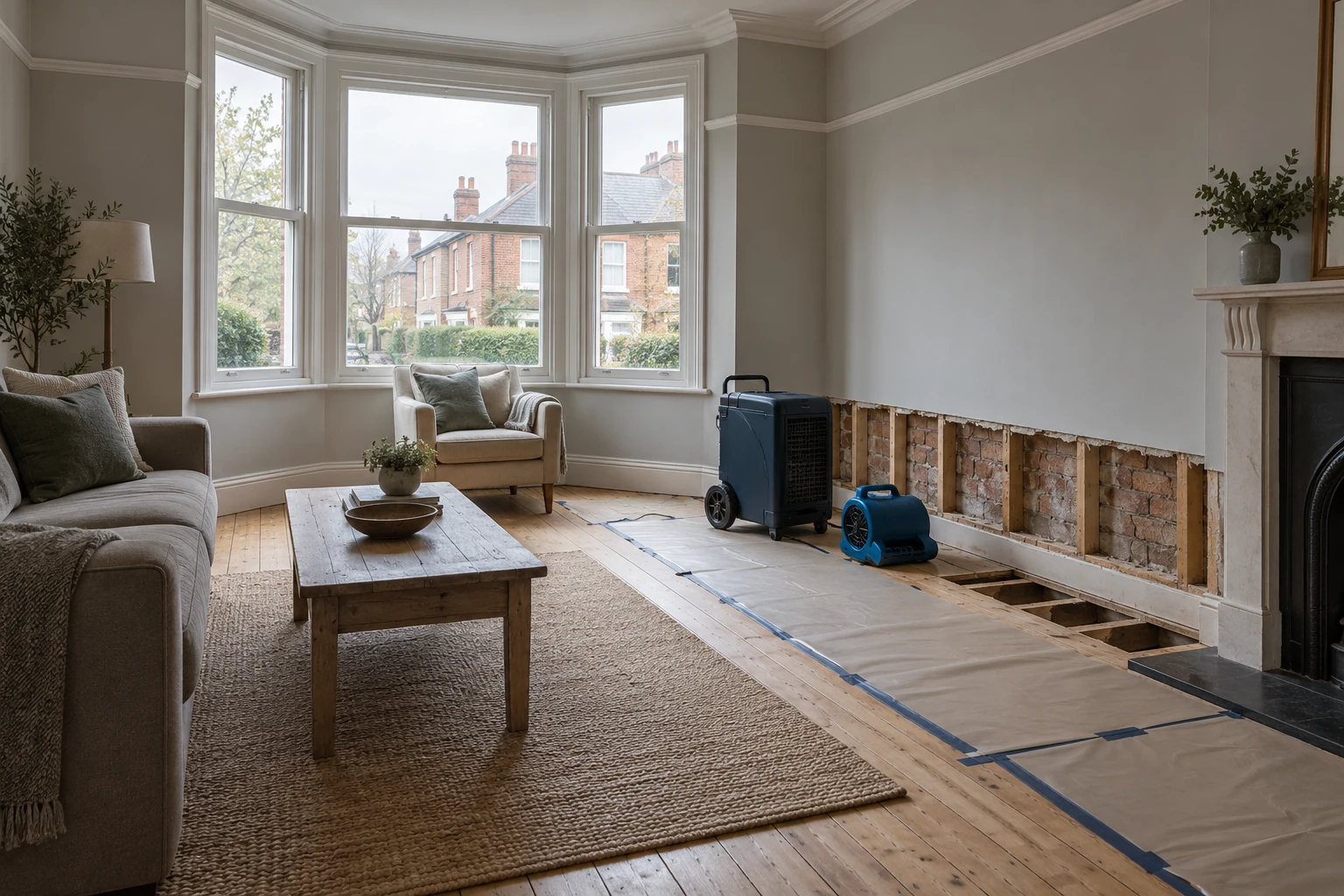
A drying setup with its routes understood
Illustrative scenes consider equipment and restoration, without representing a real Tooting incident.


QUESTIONS BEFORE THE WORK
Understand the next decision.
Can I plug a drying machine into any nearby socket?
No. Agree suitable safe provision, particularly where the incident may have affected the electrical installation.
Do refrigerant and desiccant units dispose of moisture identically?
Their methods and installations differ. Follow the actual machine’s collection, drain or wet-air instructions.
Should I add a heater to make drying faster?
Do not change the agreed environment independently. Ask the drying team to review the conditions and method.
What if a cable obstructs our normal doorway?
Raise it before accepting the setup so a suitable route can be assessed, rather than relocate equipment yourself.
Can the machine move to a newly discovered wet patch?
Report the location and let the team assess the affected extent and setup.
Does a full container prove the room is nearly dry?
No. Material readiness needs appropriate findings, not the collected water alone.
Who should decide changes to controls or ducts?
Use the responsibilities and contact route agreed with the installation team and supplied instructions.
Does hire collection mean decoration can begin?
The repair background still needs the relevant readiness assessment and accepted scope.
Can equipment hire be assumed covered by insurance?
No. Ask the insurer about the policy, evidence and claim authorisation.
NEARBY AREAS
Water damage support nearby
ASSESS. DRY. REINSTATE.
Discuss the setup before the machine arrives
Call 020 3404 2271 during published contact hours about assessment, hire and the connected repair scope.
Enquiries: Monday–Friday, 9am–6pm