
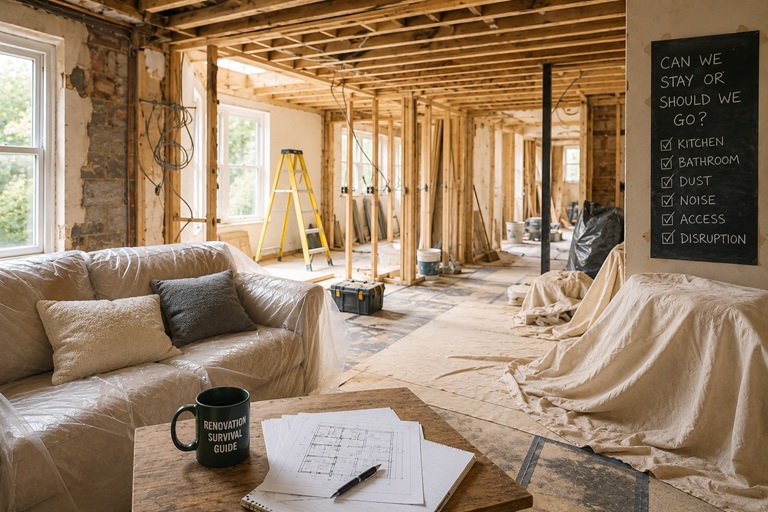
At 7:30 in the morning, the builders arrive. By 8:00, power is isolated to part of the house. The kitchen has already been stripped out, the downstairs floor is protected for deliveries and somebody needs access to the room you planned to use as your temporary office.
This is the part of living through a renovation that is difficult to understand from drawings and quotations.
Remaining at home can save the cost of temporary accommodation, and on the right project it can work perfectly well. On the wrong project, it can make everyday life frustrating while also forcing the builders to work around occupied rooms, belongings and restricted access.
The real question is not simply “Can we tolerate the mess?” It is whether the house can continue functioning as a home while also functioning as a building site.
The Answer Usually Depends on What You Lose First
A complete house refurbishment in London can involve structural work, plumbing, electrics, plastering, bathrooms, kitchens, floors, carpentry and decorating. Those stages do not all create the same level of disruption.
The first question is therefore practical: what parts of normal life disappear during the programme?
If one bedroom is being redecorated, very little changes. If the only bathroom is stripped out, the situation changes immediately. If the kitchen, heating and large sections of the electrical installation are being worked on simultaneously, the property may technically still be your home but no longer operate like one.
Water, power, cooking, washing and safe access matter far more than whether you are comfortable looking at bare plaster for a few weeks.
Scenario One: Staying Works Because the Renovation Can Be Contained
Imagine a three-storey house where the builders are renovating the ground floor first. Bedrooms and one bathroom remain untouched upstairs, and a temporary cooking area has been created in another room.
That is a very different proposition from a property where every floor is being opened at once.
Staying at home tends to work best when the construction area can be separated clearly from the occupied area. Builders need a defined route for tools, materials and waste without repeatedly moving through the rooms you are using to live and work.
A working bathroom also makes an enormous difference. Where there are two bathrooms, a bathroom renovation can sometimes be sequenced so one remains available while the other is rebuilt.
The same applies to the kitchen. A temporary setup with a fridge, microwave, kettle and sink can make a contained project manageable for a while.
None of this makes the renovation invisible. It simply means the building work and normal life have enough physical separation to coexist.
Scenario Two: You Stay for Some of the Build, but Not All of It
This is often the option homeowners overlook.
You do not necessarily need to choose between living in the property for the entire renovation and moving out for four months.
The most disruptive stages are usually concentrated into particular parts of the programme. Strip-out can generate considerable dust and noise. Structural alterations can temporarily change access through the house. Rewiring and plumbing work can interrupt utilities. Floor replacement can make whole areas unusable.
Later stages may be much easier to live with. Once the property is closed up again and the work moves into carpentry, second fix and decorating, occupying part of the house can become more realistic.
A family might therefore move elsewhere during six weeks of heavy structural and first-fix work, then return while the final rooms are completed.
This approach can reduce temporary accommodation costs without forcing everybody to live beside the most disruptive construction stages.
Scenario Three: Moving Out Makes the Building Work Simpler
Now consider the opposite project: a terraced house being stripped across both floors, rewired throughout, replumbed, structurally altered and fitted with a completely new kitchen and bathrooms.
Trying to preserve a small island of normal life inside that environment can create more difficulty than value.
The builders may need to keep temporary routes open every evening, repeatedly protect occupied rooms, move materials around furniture and sequence work according to which areas the homeowner still needs access to.
An empty property gives the team greater freedom to open floors, isolate services, move materials and coordinate different trades without having to return part of the house to domestic use every night.
That can be particularly important during a complete kitchen refurbishment, where the room may pass through demolition, plumbing, electrical work, preparation, flooring and installation before it becomes usable again.
Moving out does not automatically make every renovation faster. But on a full strip-out, removing the need to maintain occupied areas can make the programme much easier to organise.
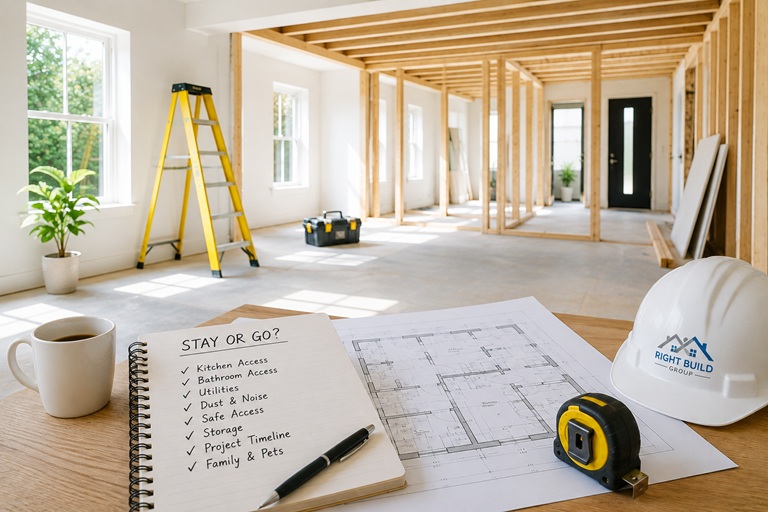
The Hidden Cost of Staying Is Not Always Financial
Temporary accommodation has an obvious price. Living through construction has costs that are harder to put into a spreadsheet.
There is the early-morning noise, dust that finds its way beyond the work area, interruptions to water or electricity and the constant movement of people through what is still supposed to be your home.
Working from home can become particularly difficult. A quiet upstairs bedroom may sound like a workable office until drilling begins below it or an electrician needs access to the same room.
Children and pets introduce another consideration. Active building sites contain temporary hazards: tools, open floors, unfinished wiring, stacked materials and areas that simply cannot be treated like ordinary domestic space.
These conditions can be managed professionally, but they still need to be taken seriously when deciding whether remaining in the property is practical.
If You Stay, the House Needs a Plan for Living as Well as Building
The construction programme should identify more than when each trade arrives. If the property remains occupied, it also needs to recognise what the homeowners require each day.
- A protected route through the property that does not constantly cross active construction areas.
- At least one usable toilet and washing facility during the relevant stages.
- A temporary cooking arrangement if the main kitchen will be unavailable.
- Clear communication about service shutdowns so water and electricity interruptions are expected rather than discovered.
- Rooms cleared of unnecessary possessions so the builders are not working around furniture and storage.
- A genuine barrier between living and construction wherever the layout makes one possible.
Without that planning, “we’ll just live upstairs” can stop being a strategy very quickly.
Decide Before the Programme Is Built Around You
The worst time to decide you cannot tolerate living through the renovation is halfway through first fix.
Whether the property will be occupied can influence site protection, sequencing, deliveries and which rooms are opened at the same time. Experienced builders in London need to know those constraints while planning the work, not after the programme is already underway.
This is also why the cheapest-looking option is not always the easiest one. Saving several weeks of rent may sound attractive, but if keeping the house habitable forces the project into a slower room-by-room sequence, the trade-off needs to be understood properly.
A Simple Test Before You Decide
Forget for a moment whether you personally dislike dust or noise. Ask three more useful questions.
Can the builders work without repeatedly passing through the area we need to live in?
Will we have reliable access to a bathroom, water, power and some form of cooking throughout the relevant stages?
Does keeping us in the house materially restrict the way the project needs to be built?
If the answers are favourable, staying may be entirely workable. If every answer involves a complicated temporary arrangement, moving elsewhere for at least part of the project is probably worth serious consideration.
A full renovation is disruptive enough without forcing a house to perform two incompatible jobs at once.
If you are planning a substantial refurbishment, contact Right Build Group to arrange a free site survey. The construction programme can then be discussed alongside how — or whether — the property needs to remain occupied while the work is carried out.